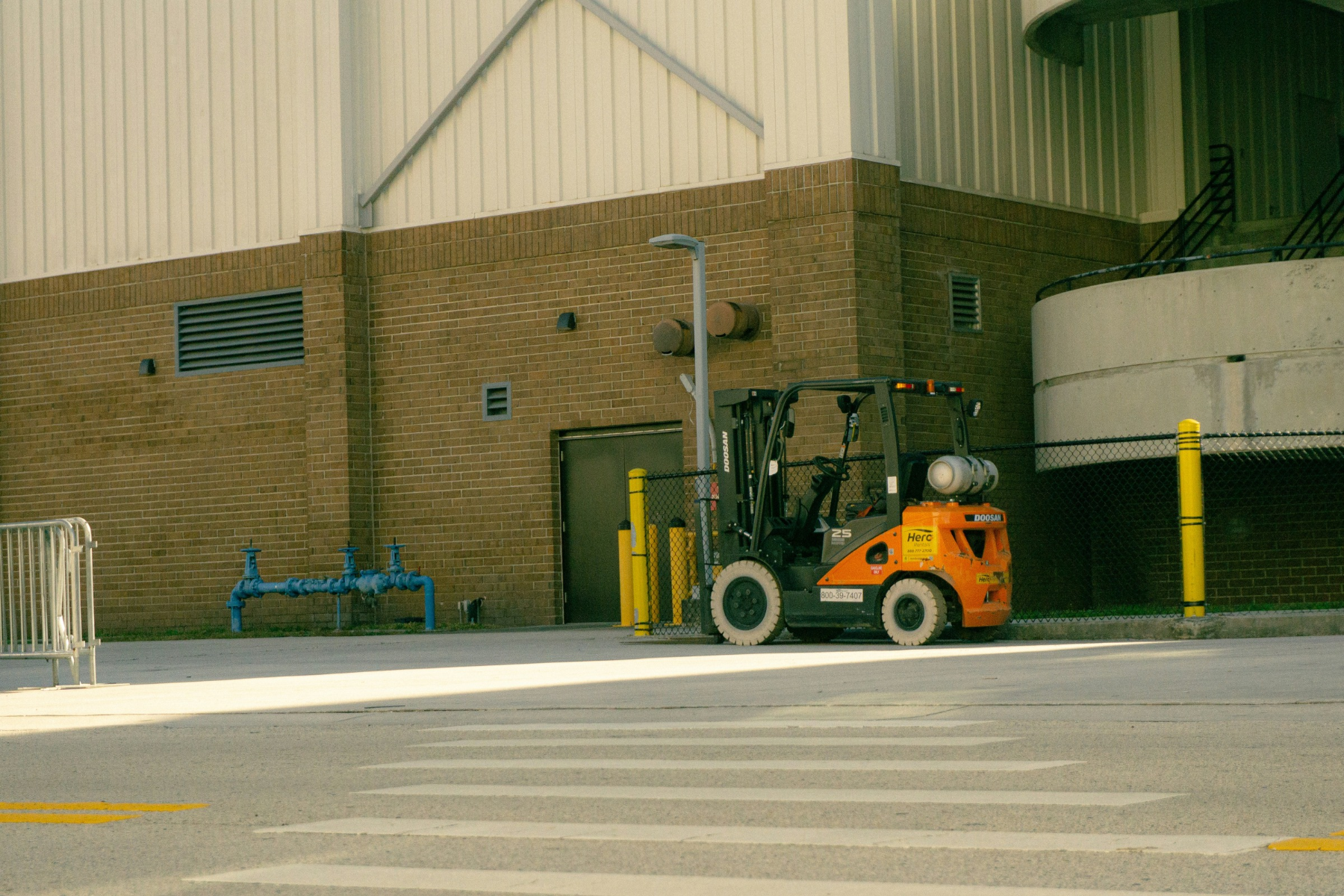

One forklift It is a self-propelled material-handling vehicle designed to lift, transport, and stack loads using a hydraulic fork and mast system. It is used in warehouses, industrial facilities, construction sites, and ports to move materials efficiently. Operating it requires specific training and authorization from the employer: it is not a vehicle for personal use.
Table of Contents
ToggleWhat is a forklift, and what is it used for in industry and on construction sites?
The forklift It combines traction, lifting capacity, and maneuverability in a compact machine. It can move pallets, containers, coils, or bulk materials, lift them several meters high, and place them on racks or into vehicles. It is commonly used in logistics, construction, manufacturing, and sectors such as food and pharmaceuticals, where the electric forklift It has gained ground due to its zero emissions at the point of use.
Types of Forklifts: Which One to Choose Based on the Application
Choosing the right type depends on the environment, the load, the lifting height, and the type of floor:
Front-loading forklifts (counterbalanced)
The forklift The front-loaded or counterbalanced model is the most common. It is available in an electric version (for indoor use, with zero emissions) and a combustion engine version—LPG or diesel—for outdoor or mixed-use environments. Typical capacities range from 1,000 to 10,000 kg.
Reach Trucks and Stackers
The retractable forklift (reach truck) is designed for warehouses with narrow aisles and high-rise racks: the mast extends forward to set down the load without the chassis entering the aisle. The electric stacker It serves a similar purpose in even narrower aisles, with lighter loads. Both are intended exclusively for indoor use.
Telescopic Handlers on Construction Sites
The telescopic forklift (telehandler) is the industry standard for construction sites and outdoor areas with uneven ground. Its telescopic boom allows it to lift and reach hard-to-access areas, with capacities of up to 6,000 kg and heights of up to 18 m, depending on the model. It requires a specific operator’s license and is subject to the RD 1627/1997 on construction sites.
Regulations and Employer Obligations Regarding Forklifts
The main regulation is the RD 1215/1997 regarding work equipment, which requires employers to ensure that the equipment is suitable, maintained in safe condition, and used only by trained and authorized workers. For construction sites, the following also applies: RD 1627/1997 on minimum safety requirements.
A business owner must have a maintenance plan Based on the manufacturer's instructions, record periodic inspections and ensure that the equipment bears the CE marking and the declaration of conformity. For more information on the regulatory framework applicable to the industrial facilities and equipment, check out our articles on the Machinery Regulations and the Regulation No. 1627/1997 on Construction Projects
Is the ID card Forklift? Operator Training and Certification
There is no official document in Spain with universal legal validity equivalent to a driver's license. What the RD 1215/1997 (Art. 19) is that the employee has received specific training for operating the equipment and that the employer has provided him with written authorization to operate it. The standard technical reference for training plans is the standard UNE 58451 (Check for validity before publishing), which establishes the minimum theoretical and practical content.
Training must cover the operation of the equipment, its stability and rated load, specific risks, applicable regulations, and basic operating procedures. It is the employer’s responsibility to document that this training has been provided and that the employee has successfully completed it.
Major Risks When Operating a Forklift and How to Prevent Them
Rollover and Loss of Stability
The forklift rollover It is the most serious and common type of accident. It occurs due to excessive load, high speed when turning, uneven ground, or a raised mast in motion. Stability depends on the triangle formed by the three support axes: exceeding the rated load or raising the load before stabilizing the equipment disrupts this balance. The standard requires that the maximum load indicated on the nameplate never be exceeded.
Accidents, Visibility, and Traffic Flow on the Factory Floor
The forklift accident It is the second leading cause of serious accidents. The operator’s visibility is limited, especially when reversing with a load. Preventive measures include marking pedestrian walkways, using mirrors at blind intersections, installing an audible reverse warning signal, and physically separating areas where people walk from equipment traffic routes.
Falling or shifting cargo
The forklift load drop This can be caused by improper securing of the pallet, forks in poor condition, or abrupt maneuvers. Before each load, the operator must verify that the forks are in good condition, that the pallet is suitable for the load it is carrying, and that the load is properly centered and, if necessary, strapped or shrink-wrapped.
Daily Inspection and Maintenance: What to Check Before Starting Your Shift
The forklift maintenance This should be done every day before starting the equipment. The operator must check the condition of the forks, the hydraulic system, the brakes, the signaling system, and the power level (battery or fuel). Recording these checks in a daily log is a recommended practice and is mandatory at many companies as part of their internal procedures.
How to Train and Certify Your Company's Operators
The formation of forklift operators It must combine a theoretical component (regulations, risks, stability, load) with a practical component using the actual equipment the worker will be operating. General training is not enough: if the worker will be operating both a reach truck and a counterbalanced forklift, he or she needs specific training for each type.
Educa PHAROS offers Training in Occupational Safety and Health in Construction and programs related to the occupational safety and health management For occupational safety and health (OSH) technicians and managers who need to structure their teams' training plans in accordance with current regulations.
Educa PHAROS Training on Prevention and Workplace Safety
If your company needs to train operators or the occupational safety and health (OSH) technical team on the safe use of work equipment, check out the Educa PHAROS catalog at Prevention and Safety or contact our team for a customized proposal.
Frequently Asked Questions About Forklifts
How often should a forklift be inspected?
The operator performs a daily inspection before each shift. In addition, the manufacturer specifies periodic inspections (typically every 250, 500, and 1,000 operating hours) that must be performed by qualified technical personnel. The employer is responsible for ensuring that these inspections are carried out and documented.
Can any employee operate a forklift?
No. The RD 1215/1997 It requires specific training and written authorization from the employer. An employee without such authorization may not operate the forklift, even if he or she has a driver’s license or prior experience with other equipment. Failure to comply constitutes a serious violation of occupational safety regulations.
What is the difference between an electric forklift and a gas-powered forklift?
The electric cart It emits no gases at the point of use, is quieter, and requires less maintenance, but it does require a battery-charging infrastructure and a smooth floor. The internal-combustion forklift (LPG or diesel) offers greater range and power for outdoor use and heavy loads, but emits exhaust gases and requires ventilation indoors. The choice depends on the environment, the intensity of use, and the facility's environmental requirements.