
Table of Contents
ToggleWhat Is a Confined Space? Definition and Examples
A confined space is any enclosure with limited entry and exit openings, inadequate natural ventilation, and that is not designed for continuous occupancy by people, but in which it may be necessary to work. Common examples include manholes, tanks, silos, wells, collectors, sewer tunnels, and inspection chambers.
The space doesn't have to be small or completely enclosed: what defines it is the risks associated with its internal atmosphere and the difficulty of evacuation in case of an emergency.
Which of these characteristics defines a confined space?
What percentage of oxygen in the air is considered a deficient atmosphere?
Which of these examples is NOT typically a confined space?
Which toxic gas becomes particularly dangerous because, at moderate concentrations, it numbs the sense of smell?
Major hazards: hazardous atmospheres, entrapment, and drowning
60% of fatalities in confined spaces occur among rescuers who enter without protection. The risks fall into three categories.
Oxygen-deficient atmospheres
The oxygen level in normal air is 20.9 %. Below the 19.5 % is considered a deficient atmosphere; Below 16 %, severe symptoms appear; below 6 %, death occurs within minutes. The deficiency may be due to oxidation of materials, fermentation, consumption by fire, or displacement by another gas.
Toxic and Flammable Atmospheres
The toxic gases The most common gases in confined spaces are hydrogen sulfide (H₂S), carbon monoxide (CO), and ammonia (NH₃). H₂S is particularly treacherous: it numbs the sense of smell at moderate concentrations, causing a a false sense of security. The flammable atmospheres They are caused by the accumulation of gases or vapors within the lower and upper explosive limits (LEL/UEL).
Regulations and Technical Reference Criteria
Spanish regulations do not include a specific, unified set of rules for confined spaces. The framework is based on the Law 31/1995 on Occupational Risk Prevention, Royal Decree 39/1997 (Regulations on Prevention Services) and, as the primary technical reference, the INSST Technical Notice No. 223 (Work in Confined Spaces), which establishes the criteria for classification, measurement, and entry procedures. The NTPs do not have the force of law, but they serve as the technical reference used by the Labor Inspectorate.
Step-by-Step Safe Work Procedure
No worker should enter a confined space without having completed the entry permit, a document certifying that the risks have been assessed and the necessary measures have been taken. The basic steps are:
- Identification and Classification classifying the space as confined, with or without special hazards.
- Atmosphere Assessment Before entering: oxygen, toxic gases, and flammability.
- Forced ventilation from the premises until conditions are safe.
- Continuous measurement throughout the entire project.
- Issuance of an entry permit signed by the person in charge.
- Appointment of a Security Guard outdoors at all times.
- Equipment Inspection rescue plan before entering.
Required equipment: gas detectors, ventilation, and PPE
The multigase detectors (O₂, CO, H₂S, LEL) are essential before and during entry. They must be calibrated, and personnel must know how to interpret them. The forced ventilation (extraction or injection) must be maintained as long as people are inside. Regarding PPE: a harness with an anchor point for vertical extraction, self-contained breathing apparatus (SCBA) if the atmosphere cannot be decontaminated, and a lifeline connected to the external rescue system.
Emergency and Rescue Plan for Confined Spaces
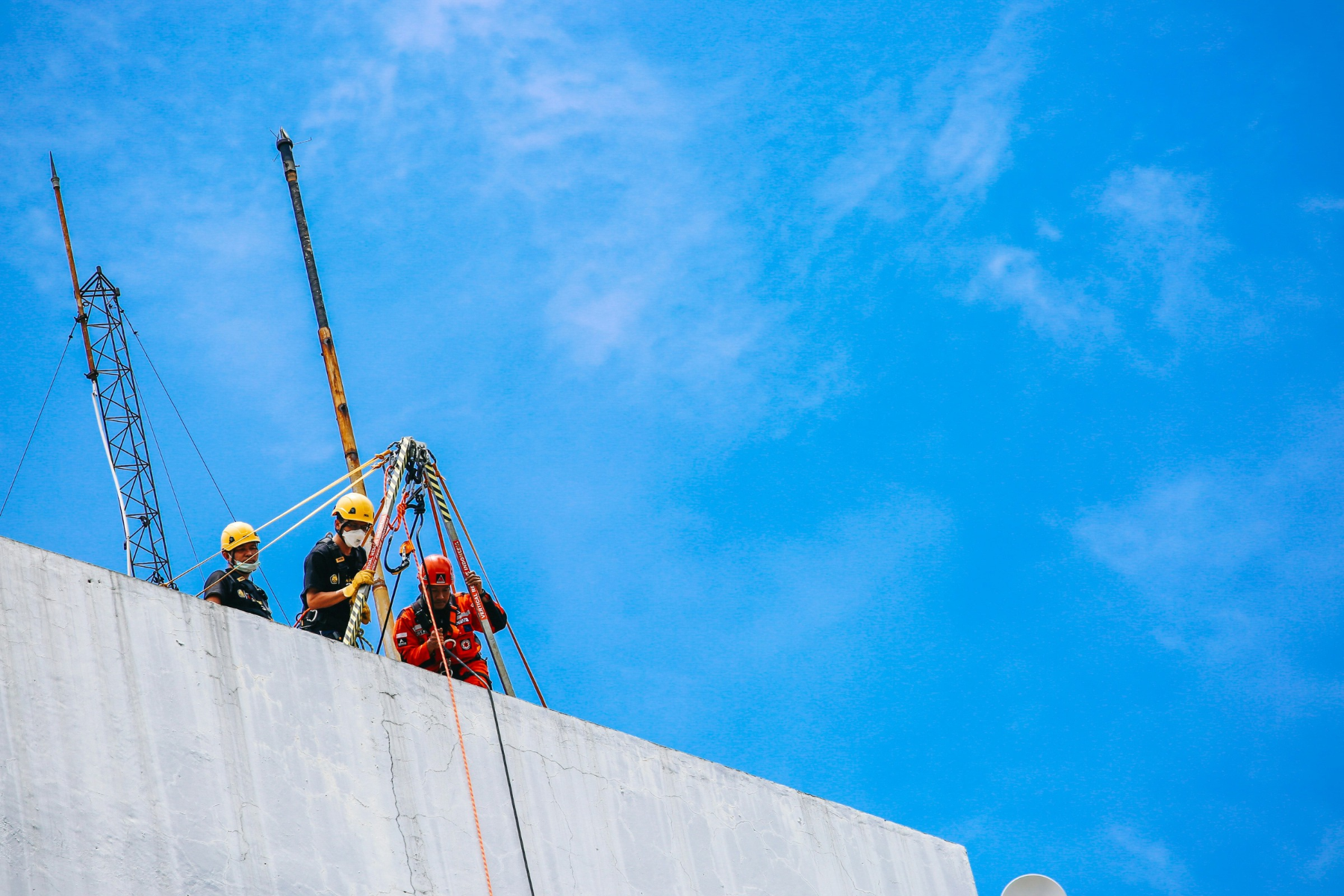
The rescue must be planned Before you go in, not when the accident occurs. The plan must define: a communication system between the worker and the spotter, rescue equipment that does not require entry into the confined space (tripod + lifting system), a procedure for alerting external services, and basic post-rescue first aid. The safety officer never enters the confined space unless wearing full protective gear and accompanied by a second external safety officer.
Mandatory Training for Working in Confined Spaces
INSST Technical Note 223 and Royal Decree 39/1997 require specific training for all personnel involved: new employees, security guards, and those responsible for granting access. The training must cover risk assessment, the use of detectors, the handling of PPE, and emergency procedures.
Educa PHAROS Training on Occupational Risk Prevention
- Occupational Safety and Health in Construction
- ISO 45001: Occupational Health and Safety Management Systems
Frequently Asked Questions About Confined Spaces
Is it okay to enter a confined space alone?
No. INSST NTP 223 stipulates that any entry into a confined space posing a special hazard requires at least two people: the worker entering the space and a spotter outside who maintains ongoing communication and can activate the rescue without entering space.
What level of oxygen is considered safe?
Between 19.5 % and 23.5 % oxygen concentration in the air. Below 19.5 %, the atmosphere is considered deficient, and entry is not permitted without self-contained breathing apparatus. Above 23.5 %, the risk of fire increases significantly.