
In the fields of engineering, industrial design, and advanced manufacturing, the digital systems have completely transformed the way products are designed and manufactured. Among the most significant technologies are CAD, CAE, and CAM, Three concepts that often appear together but serve very different functions within the development cycle.
Understanding the differences between them is essential for industrial companies, engineers, and students, as they form the foundation of modern design and manufacturing processes. From initial modeling to final production, these tools They work in a coordinated manner to improve efficiency, reduce errors, and optimize costs.
In this article, we analyze what each one is, how they relate to one another, and in which sectors they are most widely used, with a special focus on their use in Spain within the current context of the digitalized industry.
What are CAD, CAE, and CAM?
The origins of CAD, CAM, and CAE can be traced back to the The evolution of computer science as applied to engineering beginning in the second half of the 20th century. These technologies have gradually converged to form what is known in many industrial settings as CAD, CAM, CAE, and CIM, where CIM refers to computer-integrated manufacturing.
Together, these systems cover the entire product lifecycle: from initial design through manufacturing and validation.
Definition of CAD (Computer-Aided Design)
The CAD (Computer-Aided Design) Computer-aided design is the tool used to create two- or three-dimensional digital models of products.
CAD design allows engineers and designers to develop parts with high precision before they are manufactured, reducing errors and facilitating quick modifications. In the industrial sector, it is also known as computer-aided design or computer-aided design and manufacturing when it is integrated with later stages of the production process.
CAD is primarily used for:
- Create detailed technical drawings
- Design mechanical parts or structures
- Create realistic 3D models
- Simulate Basic Assemblies
Thanks to these capabilities, CAD is the the starting point of any modern industrial development process.
Definition of CAE (Computer-Aided Engineering)
The CAE (Computer-Aided Engineering) refers to the set of tools used to analyze and simulate a product's behavior before it is manufactured.
CAE engineering enables conduct virtual tests regarding strength, temperature, vibrations, or structural behavior, which reduces the need for physical prototypes.
The acronym CAE refers precisely to this approach to computer-aided engineering, where the main objective is validate the design from a technical standpoint.
Among its most common applications are:
- Structural Analysis Using the Finite Element Method
- Thermal and Fluid Simulation
- Strength and Durability Studies
- Design Optimization
This type of software is key to detect problems early in the manufacturing process, reducing costs and improving the safety of the final product.
Definition of CAM (Computer-Aided Manufacturing)
The CAM (Computer-Aided Manufacturing) Computer-aided manufacturing is responsible for transforming digital models into actual production processes.
Computer-aided manufacturing uses CAD-generated designs to program machines such as CNC machines, industrial robots, or automated systems.
It is also known as computer-aided manufacturing and it is the final step in the integrated CAD-CAE-CAM cycle.
Its main functions include:
- Generation of Machining Paths
- Machine Tool Programming
- Optimization of Manufacturing Processes
- Automated Production Control
The CAM ensures that a digital design can be turned into a physical product with the utmost precision.
How do CAD, CAE, and CAM work together?
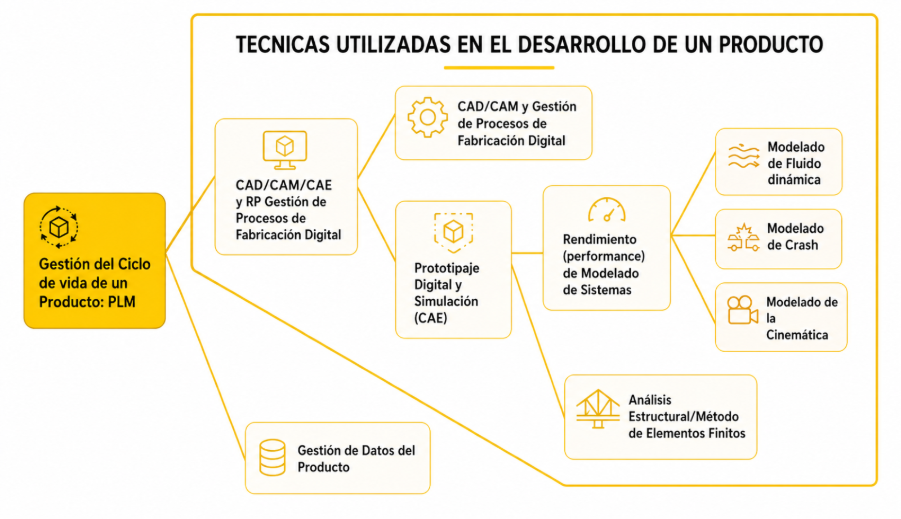
CAD, CAM, and CAE Systems they work together seamlessly within what is known as a digital engineering workflow. Each one plays a specific role within the overall process:
- CAD: creates the product design
- CAE: analyze and validate that design
- CAM: manufactures the final product
This integration ensures that the design does not remain at the theoretical stage, but rather move directly into production.
Today, CAD, CAE, and CAM software allow users to work in a unified environment, where data flows without the need to rebuild models. This results in greater efficiency and a lower margin of error.
CAD/CAM technologies have evolved into increasingly connected systems, especially in advanced industrial environments. Modern CAD/CAM software incorporates simulation, automation, and connectivity with industrial machinery, facilitating smart manufacturing.
Key Differences Between Them
Although CAD, CAE, and CAM are closely related, Their functions are clearly distinct within the industrial process.
CAD, CAE, and CAM Technologies
CAD focuses on design, CAE on validation, and CAM on execution. This separation allows for the optimization of each stage of the development cycle.
In which industries are they typically used?
CAD, CAE, and CAM technologies are used in numerous sectors industrial applications due to their ability to improve efficiency and reduce errors in product development.
Automotive
The automotive industry It is one of the leading users of these systems. They are used to design vehicles, analyze their performance under real-world conditions, and manufacture high-precision parts.
Thanks to the use of CAD and CAE, manufacturers can reduce the development time for new models and improve structural safety.
Aeronautics
In the aviation industry, Accuracy is critical. CAD systems allow for the design of complex structures, while CAE is used to simulate extreme conditions such as pressure, temperature, or vibrations.
CAM, for its part, ensures the precise manufacturing of highly specialized components.
The Use of CAD, CAE, and CAM Systems in Spain
In Spain, the adoption of CAD, CAM, and CAE technologies has grown steadily in recent years, particularly in industrial sectors such as the automotive, aerospace, energy, and advanced manufacturing industries.
Companies are committed to digitalization of their production processes as part of the transition Toward Industry 4.0.
Do leading companies in the industry use it?
Within Spain's industrial sector, numerous companies are integrating these technologies into their design and manufacturing processes. Among them are companies from the automotive, aerospace, and advanced engineering sectors that use industry-standard software solutions such as Autodesk CAD, CAM, and CAE, as well as other specialized platforms.
Regulations and Certifications
The use of these systems is part of in accordance with quality and industrial manufacturing standards, such as the ISO certifications related to quality management, design, and production processes. These standards ensure that products meet international safety and efficiency standards.
Furthermore, in regulated industries such as the aerospace and automotive sectors, the use of CAE simulations is increasingly required to validate designs before production.
Technology Trends and Adoption
In 2026, the trend in Spain points toward a greater integration between CAD, CAE, and CAM within unified cloud platforms. This enables work in collaborative environments, reduces development time, and improves project traceability.
Also worth noting is the growth in smart manufacturing, where CAD, CAM, and CAE systems are integrated with sensors, artificial intelligence, and advanced automation to optimize production in real time.