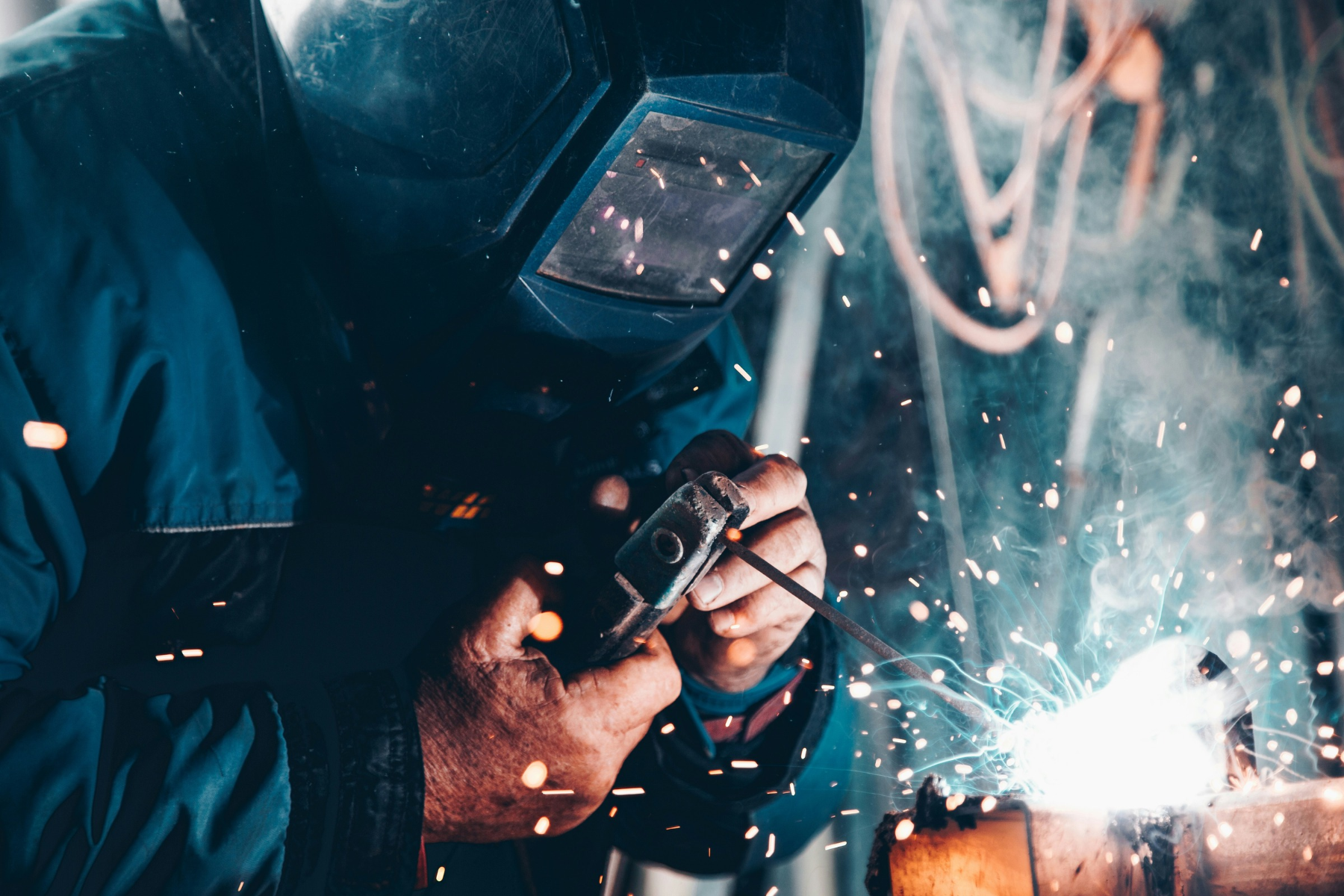

The TIG welding (Tungsten Inert Gas), also known as GTAW (Gas Tungsten Arc Welding) is an electric arc welding process in which the tungsten electrode is not consumed: it acts solely as a conductor for the arc, while the filler material is fed manually. The result is a high-quality cord, clean and free of splashes, widely used in the aerospace, food, pharmaceutical, and pipe manufacturing industries.
Table of Contents
ToggleWhat is TIG (GTAW) welding?
The TIG welding joins metals using an electric arc created between a tungsten electrode non-consumable electrode and the base material, under the protection of an inert gas. Unlike MIG/MAG or coated-electrode welding, the welder independently controls the heat (using the foot pedal or the torch) and the material feed (using the rod). This requires greater skill but allows for a level of precision that other processes cannot match.
How does the TIG process work?
The tungsten electrode and the filler material
The tungsten electrode (non-consumable) causes the arc to reach temperatures exceeding 6,000 °C at its core. The welder inserts the filler rod with the other hand, simultaneously controlling the feed rate, temperature, and amount of material. This technique is what makes the learning curve steeper compared to other processes.
Direct current (DC) and alternating current (AC)
The choice of current determines the result:
- DC negative electrode (DCEN): Concentrates heat on the workpiece, maximizing penetration. Standard for stainless steel, titanium, and copper.
- AC (alternating current): It produces a cathodic cleaning effect that removes the alumina layer. Essential for aluminum and magnesium.
Choosing the wrong current can cause defects that exceed the permissible thresholds according to the EN ISO 5817 standard.
Equipment Needed for TIG Welding
The basic kit includes a TIG torch with a ceramic or metal nozzle, the power generator with HF function for contactless ignition, the volume control pedal, the gas supply system, and—depending on the material—a water-cooling unit for extended operations. For applications in stainless steel or precision aluminum, the equipment must provide independent AC waveform control.
Shielding gases: argon, helium, and mixtures
The argon TIG welding It is the most widely used shielding gas due to its arc stability and cost. Mixtures are used to increase penetration or welding speed. argon-helium, especially in thick aluminum. The TIG welding gas It must flow both through the nozzle (bath protection) and, in pipes, through the interior of the part (root purge) to prevent the inner cord from rusting.
The proper handling of shielding gases—including storage, identification, and areas of use—is regulated. For more information on this topic, see our article on the NFPA 704 diamond and the safe handling of gases.
TIG Welding by Material
TIG Welding of Stainless Steel
The TIG welding of stainless steel This is the most common industrial application of the process. The key is to control the heat input to prevent the awareness-raising in steel (precipitation of chromium carbides at the grain boundary), which reduces corrosion resistance. DCEN is always performed using pure argon, and in pipes, with internal argon purging.
TIG Welding of Aluminum
The TIG welding of aluminum requires alternating current to break down the alumina (Al₂O₃) layer that protects the metal. This layer melts at 2,050 °C, while the base aluminum melts at 660 °C; therefore, without AC, the result is poor fusion. The use of a rod ER4043 or ER5356 It depends on the base alloy and the mechanical requirements of the assembly.
TIG, MIG/MAG, and Shielded Metal Arc Welding: Differences and When to Choose Each Process
There is no one-size-fits-all process. The choice depends on the material, thickness, welding position, environment, and the project's quality requirements:
| Process | Cord Quality | Speed | Materials | Equipment Cost | Training | Best for |
|---|---|---|---|---|---|---|
| TIG / GTAW | Very high | Cancel | Stainless steel, Al, Ti, Cu, steel | High | Sign Up | Quality and Finish. Piping, Aerospace, Exposed Stainless Steel |
| MIG/MAG / GMAW | Sign Up | Sign Up | Steel, stainless steel, aluminum | Medium | Media | Workshop Productivity: Structures, Sheet Metal, Automotive |
| Coated electrode / SMAW | Medium-high | Media | Steel, cast iron | Bass | Media | Field and maintenance. No stable power grid |
The final selection in the process must always be reflected in the WPS (Welding Procedure Specification) in accordance with the EN ISO 15614.
Industrial applications: piping, energy, structures, and maintenance
The TIG welding of pipes It is the industry standard for process facilities (chemical, petrochemical, food) where leak-tightness and weld traceability are critical. In industrial welding For lightweight metal structures or aerospace components, TIG welding is preferable when surface finish or non-destructive testing (NDT) requirements are stringent. For field maintenance or carbon steel joints in difficult-to-reach locations, coated electrodes remain the more practical choice.
Common Mistakes and How to Avoid Them
The TIG welding defects The most common are the weld porosity (gas trapped in the weld bead), lack of lateral fusion, and hot cracks. Porosity results from contamination of the electrode, moisture in the gas, or insufficient flux; lack of fusion results from excessive travel speed or insufficient current. Both defects can be detected by visual inspection (EN ISO 17637) and penetrant testing (EN ISO 3452).
Welding Safety: Radiation, Fumes, and Associated Risks
The welding safety TIG covers three main risks:
- UV/IR Radiation: The arc generates high-intensity radiation. The screen must have a minimum filter. DIN 10-11 (UNE-EN 169). Without protection, exposure causes actinic conjunctivitis within minutes.
- Fumes and hexavalent chromium: When welding stainless steel, fumes are generated that contain Cr VI, a Category 1A carcinogen. The VLA-ED in Spain is 0.005 mg/m³. Localized extraction is required.
- Electrical hazard: The no-load voltage of TIG equipment ranges from 60 to 100 V. The equipment must be grounded in accordance with the RD 614/2001.
To learn more about managing the electrical hazard In industrial settings, check out our article on Prevention of Electrical Hazards in the Workplace.
Welder Qualification and Team Training
TIG welder certification is regulated by the EN ISO 9606-1 standard (ferrous materials) and the EN ISO 9606-2 (aluminum). These standards certify that the welder is capable of performing a WPS specific to the required quality. The most in-demand levels include the position PF (upward vertical) and the PH (rotated horizontal pipe).
Educa PHAROS Welding Training
Educa PHAROS offers specialized training in welding processes For occupational safety and health (OSH) technicians and production managers who need to understand regulatory requirements, the risks associated with each process, and the applicable qualification criteria.
Frequently Asked Questions About TIG Welding
When is it better to use TIG instead of MIG?
TIG welding is preferable when the seam quality It takes priority over speed: exposed stainless steel, aluminum, titanium, process piping, and joints requiring NDT. MIG/MAG is more efficient for mass production, structural sheet metal, and when deposition rate is more important than finish.
What gas is used for TIG welding aluminum?
Pure argon (99.99 %) is the standard gas for TIG welding of aluminum. For very thick parts that require greater heat input and penetration, mixtures are used argon-helium (up to 30–50 % of helium). Helium increases the arc temperature but also increases consumption and the cost of the process.