The pro forma invoice It is a document used in business to outline the details of a transaction before the final invoice is issued. Unlike a traditional invoice, a pro forma invoice has no tax or accounting value, but it serves an important purpose: to inform the customer about prices, terms of sale, and delivery dates. In many cases, the pro forma invoice is also known as pro forma estimate or provisional invoice, and can serve as the basis for drafting a pro forma contract.
This document is particularly useful in international transactions, where customers need to know the exact costs before making payments or processing imports. Although it does not replace the final invoice, the pro forma invoice and the final invoice are usually linked, since the information on the pro forma invoice is used to generate the final invoice with tax value.
Requirements and Information for a Pro Forma Invoice
For a the pro forma invoice serves its purpose, It is important to include clear and detailed information. The absence of certain information can lead to confusion or delays in negotiations with the client.
What information must be included on a pro forma invoice?
Some of the essential elements of a pro forma model include:
- Issuer and recipient information: name, address, NIF or CIF.
- Date of issuance and pro forma number.
- Description of products or services, quantities, and unit prices.
- Delivery Terms and Payment Terms.
- Currency and payment method.
- Total amount due and any applicable taxes (although this pro forma statement has no tax implications).
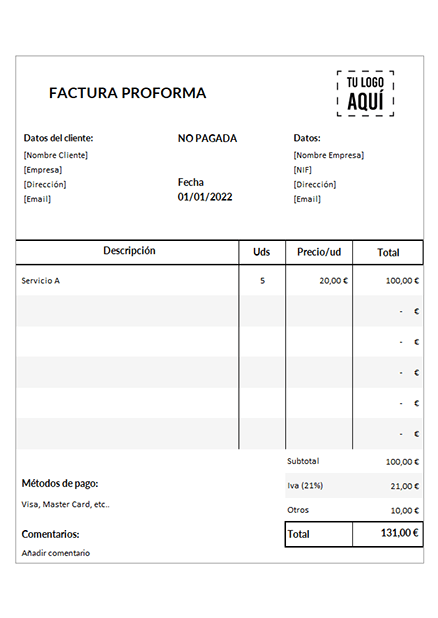
This information provides both the customer and the supplier with clarity regarding the transaction, preventing confusion and facilitating the Legal Validity of a Pro Forma Invoice in the context of prior agreements.
How do I create a pro forma invoice?
The process of preparing a pro forma invoice is relatively simple, but it requires attention to detail to ensure that it fulfills its informational and commercial purposes.
Pro forma Invoice Template
- Header: Include the company name, logo, and the title “Pro Forma Invoice.”.
- Contact information: Information about the sender and recipient.
- Product or Service Details: List showing quantities, unit prices, and totals.
- Terms and Conditions of Sale: Delivery times, shipping, insurance, and warranties.
- Total: Final amount, applicable taxes, and currency.
- Additional notes: Any comments regarding validity, payment terms, or references to pro forma contracts.
A Sample Service Proposal Template It can be easily adapted to various sectors, ranging from international trade to local service provision.
Accounting and Legal Issues
Although a pro forma invoice is not a tax document, it is important to understand its accounting and legal implications.
Can I pay a pro forma invoice?
Generally speaking, a pro forma invoice should not be used as a payment document. However, in some cases, advance payments based on the pro forma invoice are accepted, especially in international transactions. These payments are subsequently recorded on the final invoice.
How do you record a pro forma invoice?
From an accounting perspective, the provisional invoice It is not recorded as income or an expense, since it has no tax value. It serves solely as a reference for preparing the Pro forma and final invoices. Using it helps you plan collections, purchases, and cash flow more accurately.
Differences from Other Documents
A pro forma invoice is often causes confusion with other business documents. It is It is important to distinguish it clearly.
Difference Between a Pro Forma Invoice and an Invoice
The final invoice has tax and accounting value, while the pro forma invoice is for informational purposes only and has no tax implications.
Difference Between a Quote and a Pro Forma Invoice
The The budget can be more flexible and does not always specify the exact transaction. A pro forma invoice, on the other hand, usually reflects the goods or services to be delivered and their terms more accurately.
Difference Between a Delivery Note and a Pro Forma Invoice
The A delivery slip accompanies the delivery of products, acknowledging receipt. The A pro forma invoice is issued before delivery, This is just to provide information on prices and terms.
Purpose and Use of a Pro Forma Invoice
In conclusion, the A pro forma invoice is an essential tool for planning and transparency in business transactions. Although it does not replace a tax invoice, its proper preparation and use ensure clarity between the supplier and the customer, facilitate negotiations, and can serve as a reference for contracts and advance payments. With a well-structured pro forma invoice template, companies can optimize their business processes and maintain organized records of its operations prior to final billing.